
When Boroline stopped production to protect a familiar fragrance
How a Bengal-born brand’s unusual decision reveals the business value of consistency, memory and consumer trust.
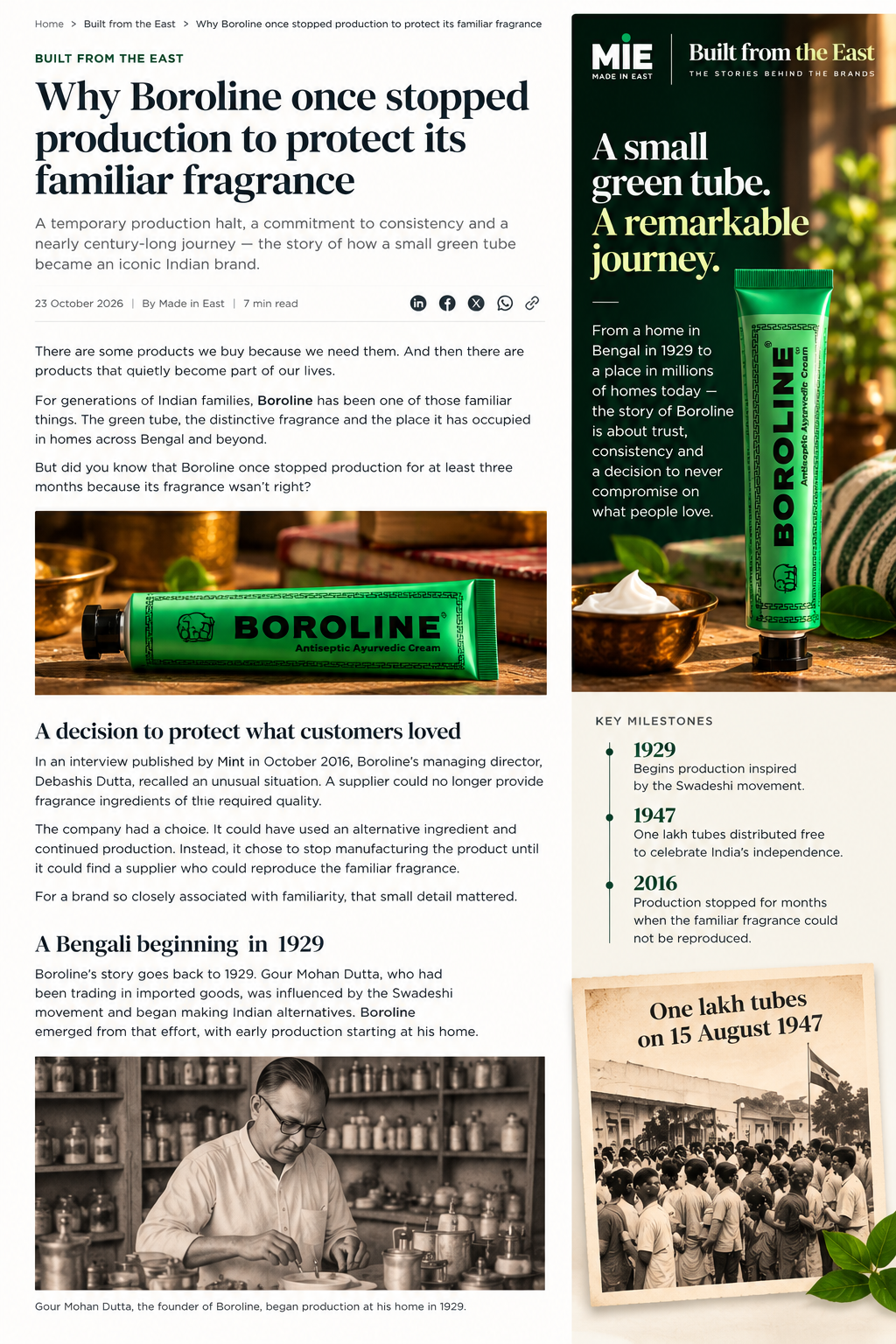
There are products we buy because we need them. And then there are products that become part of our lives so quietly that we barely notice when they turn into memories.
For generations of Indian families, Boroline has belonged to the second category. The green tube. The unmistakable fragrance. The familiar place it occupied in homes across Bengal and beyond.
But there was a time when the company behind Boroline faced an unusual dilemma: what happens when a product can still be manufactured, but one of the things that makes it familiar can no longer be reproduced?
The company stopped production.
The fragrance that was too important to change
In Mint’s 2016 interview, GD Pharmaceuticals managing director Debashis Dutta said a fragrance supplier could no longer match its previous ingredient quality. Production was suspended for at least three months until another supplier could reproduce the familiar scent.
That is a striking decision for a manufacturer. A pause can mean missed sales, gaps on shelves and difficult conversations with distributors. The interview does not quantify those costs.
What it does describe is a choice: keeping production moving mattered less, in that instance, than keeping the experience recognisable.
A brand born from Bengal’s Swadeshi spirit
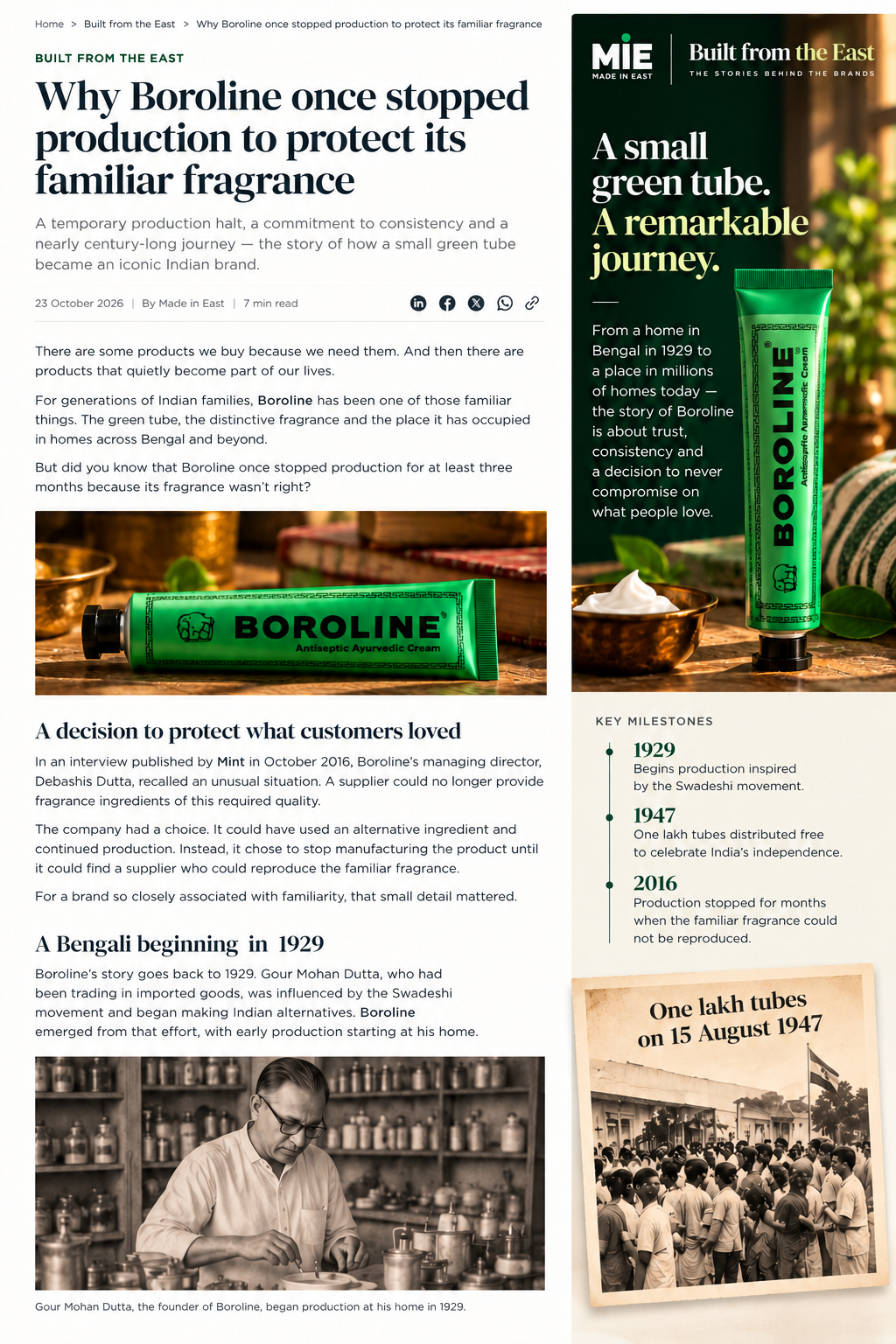
Boroline dates its beginnings to 1929. Its official history describes how Gour Mohan Dutta, an importer influenced by the Swadeshi movement, began making Indian alternatives at home. Quality was central to the proposition: a locally made product should be able to compete with imported goods.
The ambition was commercial, but it also belonged to a wider idea of economic self-reliance. A brand could help build confidence in Indian manufacturing through something as ordinary as a household purchase.
The company says it marked independence on 15 August 1947 by distributing one lakh Boroline products free. Mint’s historical account identifies them as tubes. That gesture connected a familiar consumer product with a defining national moment.
A short history. A long memory.
Boroline’s beginnings, according to the brand’s official history.
The company marks independence with a free distribution of one lakh products.
Mint publishes Dutta’s recollection of the earlier fragrance-related production pause.
How an ordinary product becomes extraordinary
Over time, everyday use creates something advertising alone cannot guarantee: familiarity.
For one person, a fragrance might recall winter evenings. For another, a parent’s cupboard, a grandmother’s home or the small collection of essentials packed before a journey.
They help explain why a product can become meaningful beyond its immediate use. The memory is built through repetition: the same colour, the same feel, the same reassuring experience.
Marketing often celebrates novelty. Heritage brands face another question alongside it: which familiar elements are still doing valuable work?
The business value of not changing
The fragrance episode is useful because it makes a usually invisible trade-off concrete. Output, inventory and sales are countable. The value of recognition is harder to isolate.
Yet a consumer can notice a change long before a spreadsheet can explain its effect. A product may remain functionally similar while feeling unexpectedly different.
Our reading of the episode is that Boroline’s management treated the familiar scent as part of its product promise.
Nor is consistency an argument against all innovation. A business can improve packaging, distribution or access while protecting the qualities its customers rely on. The judgement lies in knowing which is which.
A lesson from Bengal for businesses everywhere
Nearly a century after its beginnings, Boroline offers a way to think about regional enterprise and national recognition. Its story connects a Bengal entrepreneur’s manufacturing ambition with generations of everyday use.
The most revealing chapter is a pause: a company deciding that an easily overlooked detail deserved to be preserved.
It might be the taste of a familiar food, the feel of a material or the reliability of a service. The point is to understand what people trust you to preserve.
Sometimes, the smallest details carry the greatest brand value.
A Sunday story.
A different way to see business.
Follow Made in East for Eastern India’s business news and the stories behind its enterprises.
Which brand belongs here?
A familiar product. An overlooked founder. A business decision worth remembering. Suggest an Eastern India brand and tell us why its story matters.
Suggest a brand →Sources, dates & editorial context
- Mint: interview with Debashis Dutta, 13 October 2016. Source for the fragrance-related pause of at least three months. The wording combines “early 1990s” with “1998 or 1999”; an exact shutdown year is therefore left unspecified.
- Boroline / G.D. Pharmaceuticals: official brand history. Company’s account of its beginnings, founder and Swadeshi connection.
- Boroline’s official About Us page and Mint’s companion report, 13 October 2016: independence distribution.
The business analysis and examples of personal memory are MIE’s interpretation. This article does not report a present shutdown, quantify consumer sentiment or suggest the brand nearly ceased to exist. No new interview or company endorsement is implied.
Built from the East — The Stories Behind the Brands. An editorial series by Made in East, exploring the businesses, founders, decisions and ideas that have shaped Eastern India’s entrepreneurial legacy.
Visual storytelling. Supplied illustrated scenes are not historical photographs. The imagined workshop figure is not an authenticated portrait of Gour Mohan Dutta. The factual article and its sources are separate from these illustrations.
Built from the East is an editorial series by Made in East. Editorial policy · Corrections and feedback.