
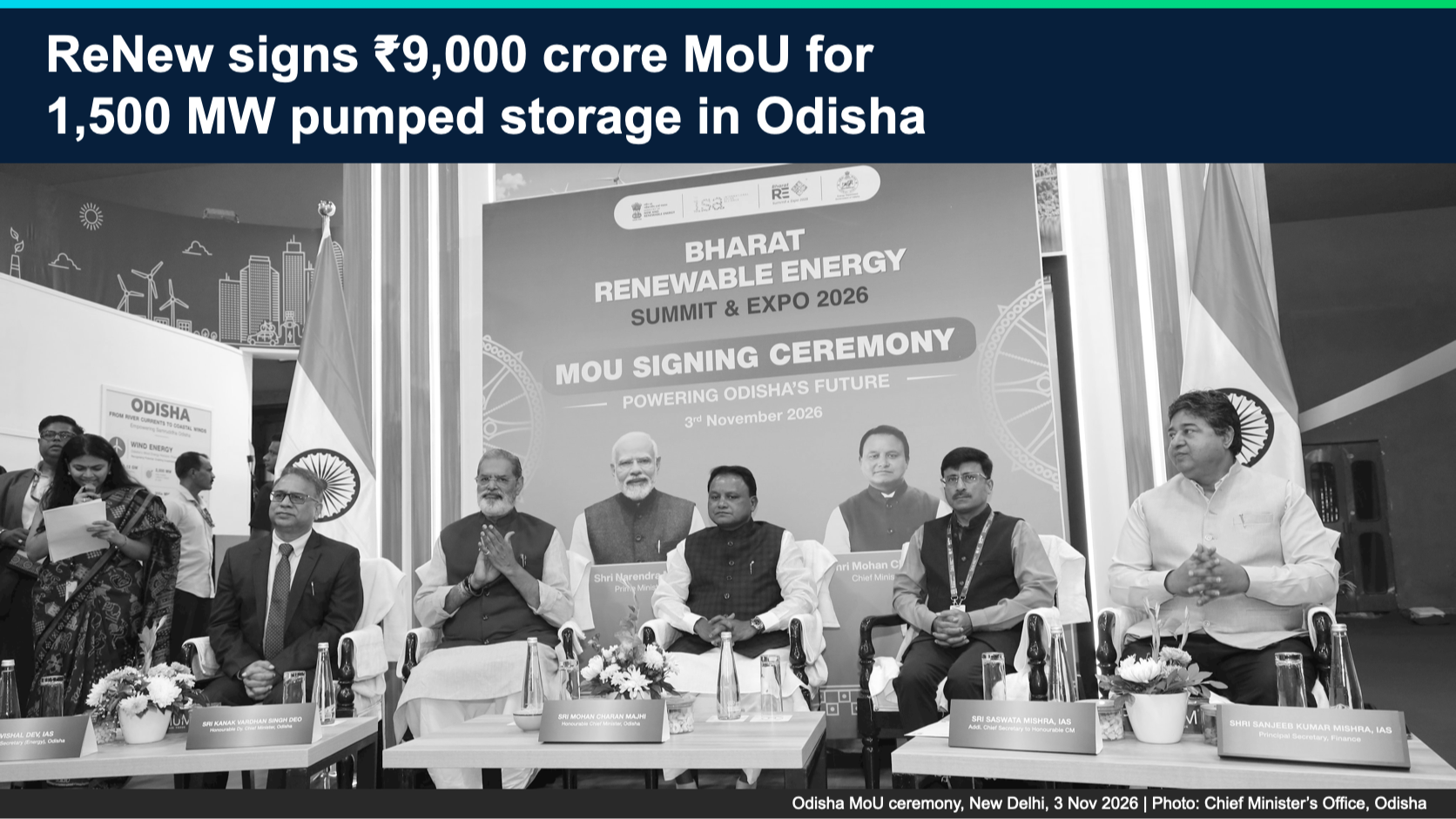
ReNew has signed a memorandum of understanding with the Odisha government for a proposed 1,500 MW pumped hydro storage project at Putabali in Ganjam district, with an estimated investment of ₹9,000 crore. The company confirmed the capacity, location and investment estimate in its 3 November announcement.
The MoU was signed at the Bharat Renewable Energy Summit and Expo 2026 in New Delhi. Odisha’s Chief Minister’s Office confirmed that the state exchanged 18 MoUs at the event on 3 November, covering prospective investments of approximately ₹1.17 lakh crore across clean-energy technologies. That is the wider event total, not the value of ReNew’s project. Official Odisha announcement
What the ₹9,000 crore proposal covers
The ReNew announcement identifies a pumped hydro storage development with a proposed power capacity of 1,500 MW. It does not establish that the plant is under construction or that the estimated investment has been spent.
Business Standard reports that the Putabali proposal forms part of ReNew’s broader investment plans of approximately ₹45,000 crore in Odisha. The two figures describe different scopes: ₹9,000 crore relates to this storage proposal; ₹45,000 crore describes the company’s wider state plans. They should not be added together as separate confirmed investments. Business Standard report
Why it matters for Odisha’s energy infrastructure
ReNew says the proposed project would support grid flexibility, renewable energy integration and reliable clean power. For Odisha’s industrial economy, storage is relevant to the challenge of matching electricity supply with demand as the clean-energy system expands.
If the proposal progresses to implementation, it could create procurement opportunities across civil engineering, electrical systems and associated infrastructure. That is an implication of future development, not evidence of contracts already awarded. The sources reviewed do not identify supplier packages, employment commitments or a local spending breakdown.
What to watch after the MoU
The next useful milestones will be project approvals, a disclosed implementation timetable, financing arrangements and procurement announcements. A commissioning target and storage duration were not established in the sources reviewed. The 1,500 MW figure describes proposed power capacity; it should not be presented as energy-storage capacity in MWh.
MIE will track those subsequent disclosures separately so readers can follow the project from agreement through execution. For more regional coverage, visit the Made in East website.
Photo: Odisha’s MoU signing ceremony at the Bharat Renewable Energy Summit, New Delhi, 3 November 2026. Chief Minister’s Office, Odisha. The photograph shows the wider ceremony, not a separately identified ReNew document exchange.